
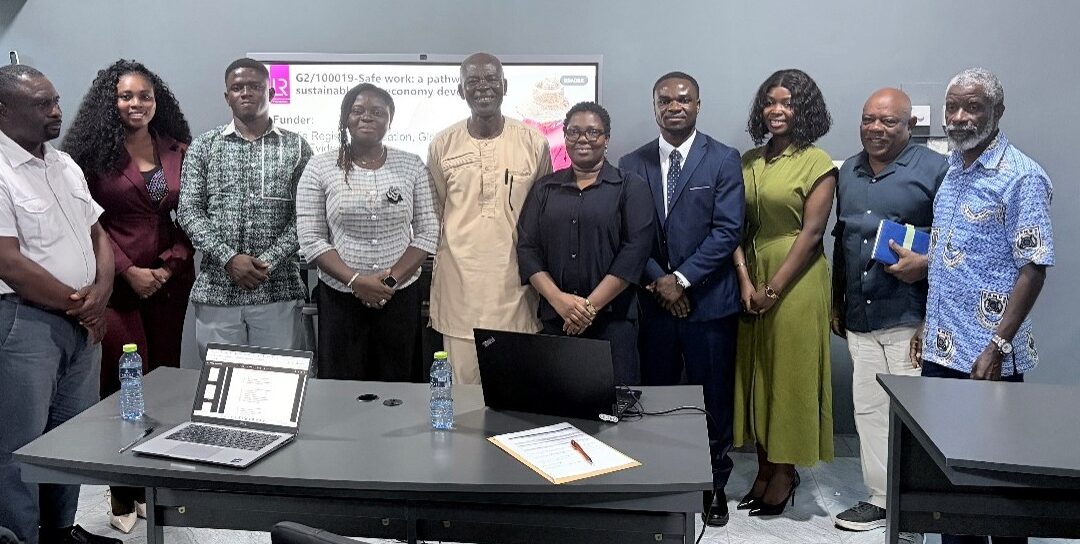
Representatives of IAR and RMU, together with members of the Advisory Group, pose for a group photograph following the maiden Advisory Group meeting.
Accra, Ghana – 1 September 2026
BY MARY OWUSU
The Institute of Applied Research (IAR) and the Regional Maritime University (RMU), partners on the Lloyd’s Register Foundation-funded research project, convened its maiden meeting with the Project Advisory Group on September 1, 2026 at RMU’s campus in Accra to deliberate on strategic direction for the initiative.
The project, entitled SAFE WORK: A Pathway to Sustainable Blue Economic Development, is a two-year initiative, funded by the Lloyd’s Register Foundation Global Safety Evidence Centre, that seeks to address a critical evidence gap on effectiveness of interventions implemented to promote occupational health and safety (OHS) of seafarers. Although the maritime sector remains vital to the global economy through fisheries, transportation and offshore energy, it continues to record high rates of accidents and fatalities. Despite various efforts in strengthening international standards and interventions, evidence of their effectiveness remains fragmented across academic and grey literature, limiting policymakers’ ability to compare outcomes to make informed decisions. The project aims to fill this knowledge gap by conducting a mixed-methods systematic review to synthesise evidence on the effectiveness of OHS interventions for seafarers and analyse maritime accident incident data sets. The outcome of this study will provide policymakers and industry leaders with actionable evidence on effective OHS interventions.
The maiden Advisory Group meeting brought together key maritime stakeholders, researchers and industry experts. It aimed to ensure that the project is grounded in stakeholder needs and industry realities from the outset, while gathering input to guide implementation. The meeting formally introduced the project, fostered a shared understanding of its purpose and planned activities, and secured strategic oversight and technical guidance to support effective implementation and policy relevance. Discussions focused on four key areas: validating the approaches for each work package; identifying practical considerations that may shape implementation; exploring opportunities to strengthen stakeholder engagement throughout the project lifecycle; and obtaining expert advice on priorities, risks and collaborative pathways to enhance uptake and impact.
The meeting was chaired by the Project Advisory Group Chairperson, Prof. Nii Noi Dowuona, who underscored the importance of evidence-based interventions to protect maritime workers and commended the IAR–RMU partnership for leading the timely initiative. In his opening remarks, the Acting Vice-Chancellor of the Regional Maritime University, Dr Jethro W. Brooks Jnr., reaffirmed RMU’s commitment to collaborative research that advances safety and sustainability in the maritime sector and strengthens the links among research, industry practice and blue economy development.
Members of the Advisory Group commended Lloyd’s Register Foundation for funding the timely initiative and offered valuable insights into aligning the research with national and international maritime safety priorities, ensuring inclusivity across different maritime populations, and maximising policy influence.
The Project Advisory Group brings together high-level representatives from key institutions shaping Ghana’s and the region’s maritime landscape, including the Ghana Maritime Authority (GMA), Ghana Shippers’ Authority (GSA), Friends of the Nation (FoN), Ghana Merchant Navy Officers’ Association (GMNOA), Ghana National Canoe Fishermen Council (GNCFC), Ghana Fishermen Association, Fisheries Commission (FC), Maritime Organization of West and Central Africa (MOWCA), and Ocean Centres Ghana.
The IAR team was led by Dr. Paul Boadu, and comprised Dr. Kwaku Antwi, Ms. Mary Owusu, Dr. Mavis Akuffobea-Essilfie, and Mr. Bawa Ibrahim, alongside RMU’s project team led by Dr. Amy Pascalia Abra Asimah and including Dr. Robert Nyemah and Dr. Isaac Animah.
Through this maiden convening, IAR and RMU have laid a strong foundation for collaborative oversight and strategic alignment. The meeting reinforced IAR’s capacity to lead complex, multi-stakeholder research initiatives and RMU’s role as a regional centre of maritime excellence. The collaboration seeks to ensure that the project delivers rigorous, policy-relevant evidence that improves the safety and well-being of seafarers and contributes meaningfully to a sustainable and inclusive blue economy globally and Ghana in particular.