
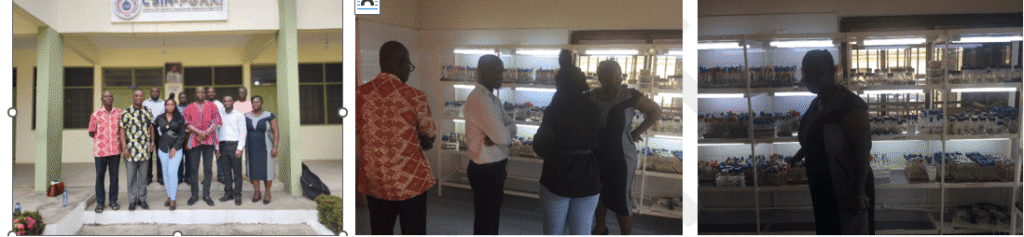
Baseline consulting team from IAR, interacting with CSIR-Crop Research Institute’s focal persons and staff at Fumesua, Kumasi
January 11, 2024
BY MARY OWUSU
The West Africa Food Systems Resilience Programme (FSRP) continues to promote collaboration, knowledge exchange, and institutional strengthening across the agricultural research and innovation (R&I) landscape in West Africa. As part of the FSRP baseline assessment in Ghana, the Institute of Applied Research (IAR), the consulting agency engaged to undertake the baseline assignment for the project, conducted a series of stakeholder engagements and institutional visits between November 2023 and January 2024.
IAR engaged with key agencies within Ghana’s agricultural research and innovation system. These included relevant directorates, authorities, and boards under the Ministry of Food and Agriculture, the Ministry of Trade and Industry, the Ministry of Environment, Science, Technology and Innovation, as well as private-sector stakeholders. Among the institutions consulted were the Ghana Meteorological Agency; CSIR research institutes, including the Savanna Agricultural Research Institute (CSIR-SARI), Crops Research Institute (CSIR-CRI), and Plant Genetic Resources Research Institute (CSIR-PGRRI); the West Africa Centre for Crop Improvement (WACCI); and private-sector organisations such as Farmerline and Esoko.
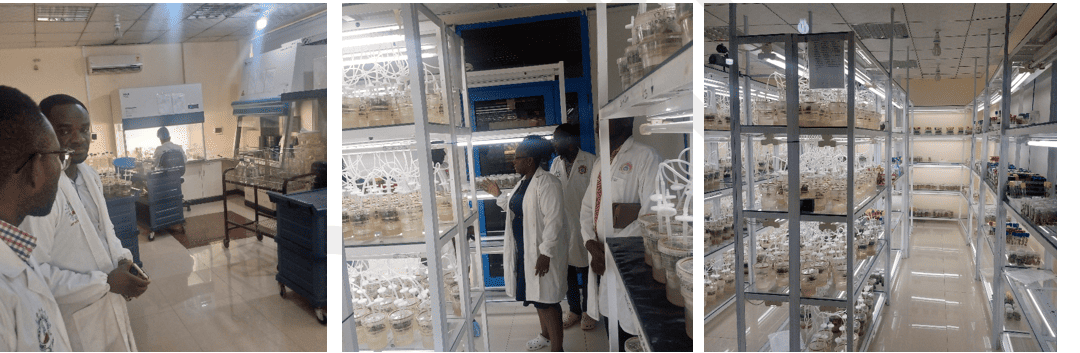
The IAR team visiting CSIR-PGRRI and inspecting genetic-resource conservation facilities
The engagements involved discussions with leadership and technical staff to assess the current operational and research capacities of participating institutions. They also sought to evaluate the preparedness of implementing agencies to achieve the project’s development objectives and to identify the potential role of the FSRP in strengthening institutional capacity and improving service delivery. The approach included facility tours, stakeholder consultations, and presentations on ongoing initiatives.
The visits provided valuable insights into ongoing research activities, capacity-development efforts, technological innovations, operational challenges, and institutional priorities shaping Ghana’s agri-food system. They also highlighted investments in plant breeding, genetic resource conservation, research infrastructure, human resource development, and technology dissemination. Furthermore, the engagements underscored a common priority across institutions: strengthening linkages among research organisations, universities, policymakers, development partners, farmer organisations, and the private sector to accelerate the translation of innovations from laboratories and training centres to farmers’ fields.
The findings from these engagements informed recommendations provided to the FSRP Project Coordinating Unit to support the effective implementation of the programme in Ghana. The baseline study and survey also established critical benchmarks for monitoring progress and assessing the effectiveness of implementation modalities, thereby supporting efforts towards a more resilient, inclusive, and sustainable food system in Ghana and across the sub-region.
This assignment builds on IAR’s growing collaboration with state and non-state actors in advancing evidence-informed agricultural policy and food systems transformation.